
A business founder told me recently:
“We review our numbers every month. Our bookkeeper sends us the P&L.”
I suggested we look at it together — and he confidently pulled up a copy.
The report looked professional, with revenue, costs and net profit.
On the surface, everything was there.
But when we looked more closely, something important was missing.
There were no accruals. No prepayments. No work-in-progress adjustments. No depreciation.
Now, those are technical accounting terms (please don’t let your eyes glaze over).
The key point is this: the numbers weren’t wrong. They were incomplete.
The business’s very capable bookkeeper had recorded the transactions accurately — but the figures hadn’t been adjusted in the way an accountant would typically adjust them.
Which meant the owner was making decisions based on numbers that didn’t tell the full story.
And that’s just as risky as making decisions with no numbers at all.
To be clear, I don’t blame the bookkeeper.
They were doing exactly what was expected of them.
A bookkeeper’s role is transactional — processing invoices, recording payments, reconciling bank accounts, running payroll and submitting VAT returns.
It’s the foundation of every accounting function.
But it isn’t the same as accounting.
Accounting goes further. It takes those raw numbers and applies adjustments that aren’t triggered by day-to-day transactions — for example, recognising depreciation on fixed assets, accounting for work in progress properly, or matching costs to the period they relate to.
These don’t simply “happen” in the software. They require technical training and judgement.
And this is where the confusion often arises.
If you’ve had the same bookkeeper for years, you may feel finance is “covered”.
Sometimes there’s also an external accountancy firm that steps in occasionally — to prepare year-end accounts, deal with tax or run payroll.
But if that input is periodic or reactive, and no one is consistently producing complete, technically robust management accounts…
And if no one is helping you use those numbers to make better decisions…
Then you don’t have a full accounting function.
You have part of one.
In my last email, I shared a pyramid that illustrates this clearly:
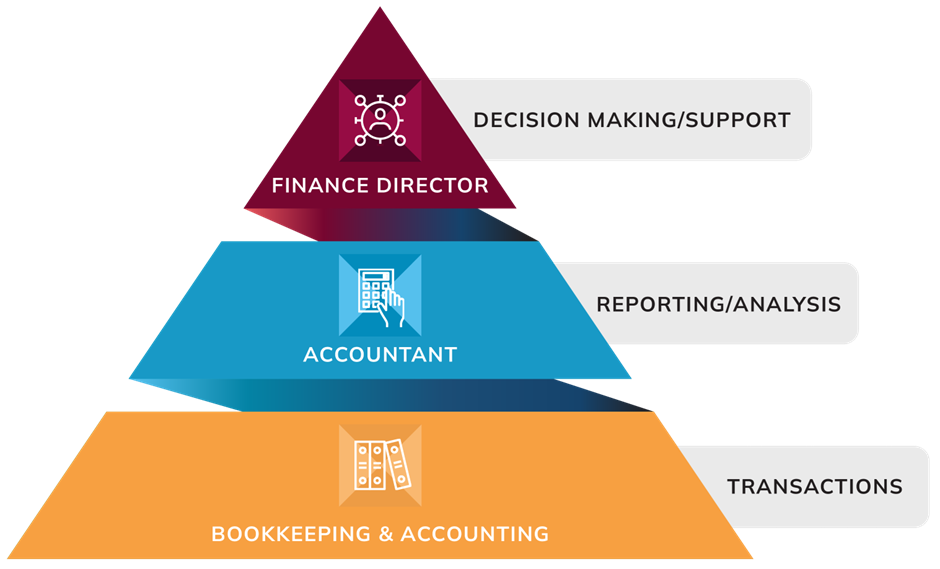
The three layers work together as a system.
The bottom layer deals with transactions — bookkeeping.
The middle layer is accounting — ensuring the numbers are complete and reliable.
The top layer is strategic — using those numbers to guide decisions.
If the middle layer is weak or irregular, the top layer simply can’t function properly. And that has consequences.
Profitability may not be measured accurately. Margins can appear stronger — or weaker — than they really are. Cash forecasts become less dependable.
Hiring, investment and pricing decisions end up being based on partial information.
Again, this isn’t about whether your bookkeeper is competent.
It’s about recognising that bookkeeping, accounting and financial leadership are different skillsets. They become progressively more technical — and more strategic — as you move up the pyramid.
You need all three layers working together if your finance function is going to do more than just record history.
When all three are in place, the numbers are processed properly.
They’re adjusted correctly. And they’re actively used to guide decisions.
That’s what a professionalised finance function looks like.
And that’s what we build at Insight Associates.
We don’t replace your bookkeeper. We don’t simply produce year-end accounts. We ensure the full system is operating — transactional accuracy, technically robust accounting, and Finance Director-level oversight.
So your numbers are not only timely and accurate… they’re useful.
They help you see what’s really happening in the business.
They help you plan.
And they help you make decisions with confidence.
If you’re unsure whether your reporting is complete — or whether you’re missing one of these layers — let’s have a conversation.
Email garry@insightassociates.co.uk or call us on 01279 647 447. We’ll review what you currently have in place, identify any gaps, and outline what a fully functioning finance structure should look like at your stage of growth.
Yours,
Garry
You might also like: Transforming your financial mindset – Insight Associates Limited